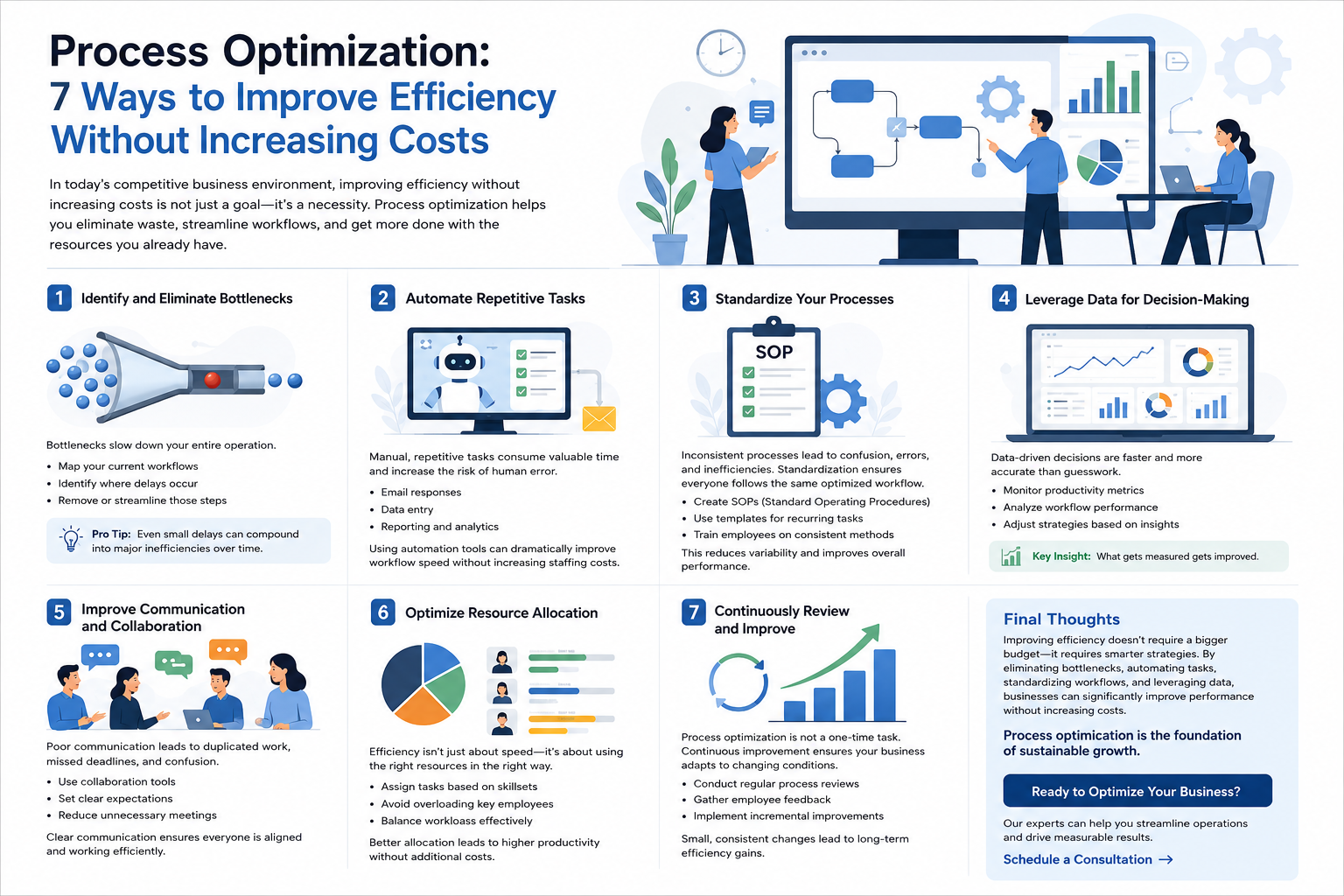
Every business has processes - the invisible rails that guide how work gets done, decisions get made, and value gets delivered. When they work well, you barely notice them. When they don't, everything feels harder than it should.
The tricky part? Most companies don't realize their processes are the problem. They blame the market, the team, the economy. But underneath many stalled growth stories is a simpler culprit: operations that were built for a version of the business that no longer exists.
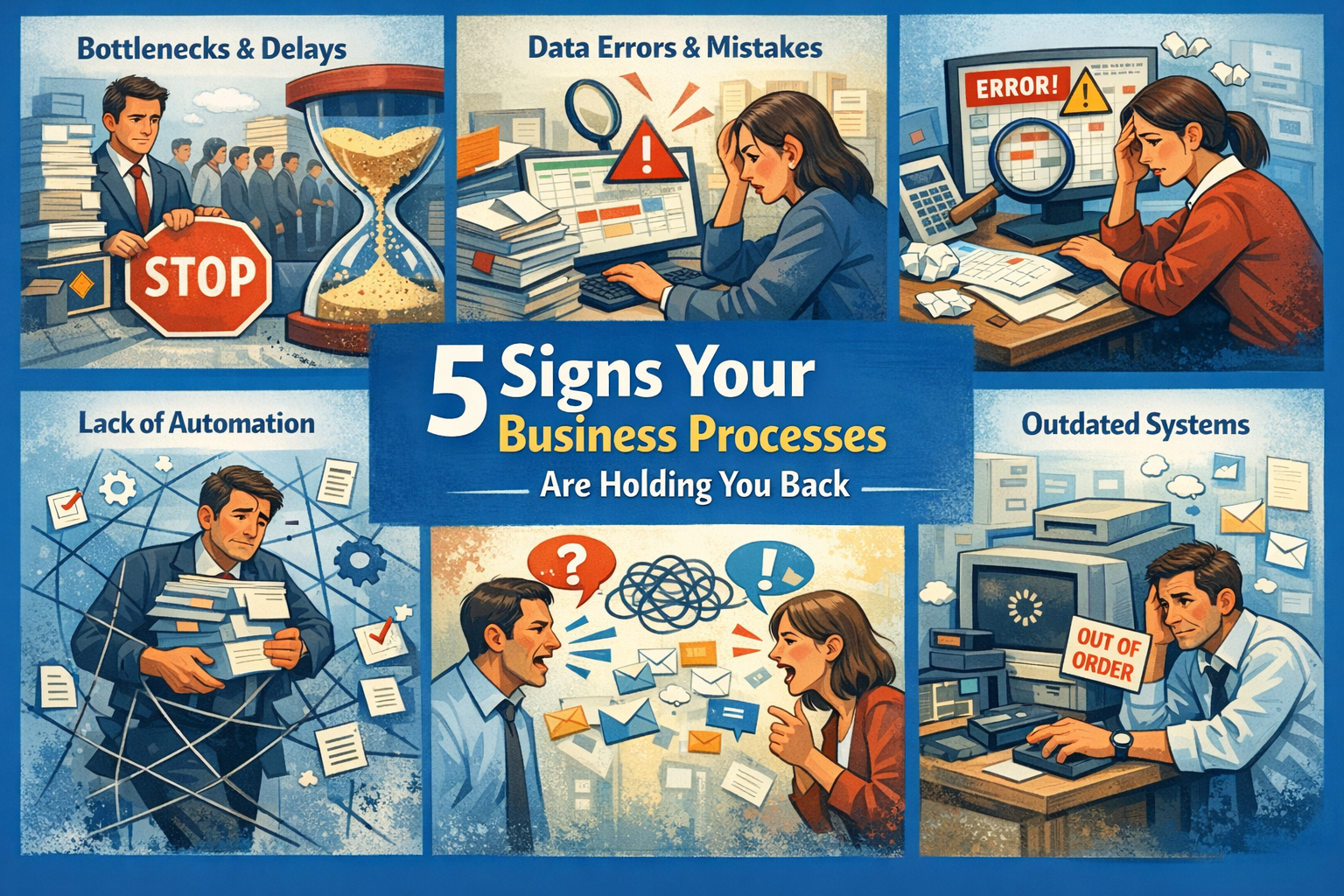
Here are five telltale signs your processes are quietly sabotaging your success - and what to do about each one.
Sign #1: Your Team Spends More Time Reporting Than Doing

If your people are spending significant chunks of their week pulling data, formatting reports, updating spreadsheets, and sitting in status meetings - that's a red flag. Reporting is a support function, not a core one. When it starts consuming your team's best hours, it usually means your systems aren't talking to each other and your workflows lack automation.
What it costs you: Creative energy, strategic thinking, and morale. High performers didn't sign up to be data janitors.
How to Fix It
- Audit where time actually goes. Ask your team to log their tasks for one week. The results are often shocking.
- Identify what can be automated. Recurring reports, data pulls, and status updates are prime candidates for tools like Power BI, Zapier, or purpose-built dashboards.
- Redesign your meeting cadence. Most status meetings can be replaced with async updates and exception-based check-ins.
"If a task is done the same way every time, a machine should be doing it - not your best people."
Sign #2: New Employees Take Forever to Get Up to Speed

When onboarding a new hire feels like passing down tribal knowledge - relying on shadow training, informal mentors, and "just ask Sarah, she knows how it works" - your processes aren't documented, standardized, or scalable.
This is especially costly in fast-growing organizations. Every new hire that takes six months to become productive is six months of lost contribution.
What it costs you: Scalability. You can't grow faster than your ability to bring new people up to speed.
How to Fix It
- Document processes as they happen. Tools like Notion, Confluence, or even structured Google Docs can turn tribal knowledge into transferable systems.
- Create role-specific playbooks. A new sales rep, ops coordinator, and customer success manager all need different onboarding paths.
- Build in feedback loops. Have new hires flag gaps in documentation during their first 90 days - they're uniquely positioned to spot what's missing.
Sign #3: Small Decisions Keep Escalating to Leadership

If your managers or executives are regularly pulled into decisions that shouldn't require their level of authority, your organization lacks clear decision rights. This bottleneck slows everything down and signals a deeper trust or process problem.
Common symptoms include: approvals that require multiple sign-offs for low-risk actions, unclear ownership of outcomes, and team members who default to asking instead of deciding.
What it costs you: Speed. In a fast-moving market, the ability to decide quickly is a competitive advantage.
How to Fix It
- Map your decision types. Categorize decisions by risk level and frequency, then assign clear ownership at each tier.
- Use a RACI framework. Clarifying who is Responsible, Accountable, Consulted, and Informed for each process eliminates confusion and reduces unnecessary escalation.
- Empower your middle layer. Train managers not just on what to decide, but on how to make good decisions - then trust them to do it.
Sign #4: You're Constantly Putting Out the Same Fires

Recurring crises are a symptom of unaddressed root causes. If your customer service team fields the same complaints week after week, if your production line hits the same bottleneck every quarter, or if the same type of project always runs over budget - the problem isn't bad luck. It's a process gap that hasn't been closed.
Reactive organizations spend so much energy fighting fires that they never find time to install sprinkler systems.
What it costs you: Resources, reputation, and the mental bandwidth of your best problem-solvers.
How to Fix It
- Run a root cause analysis on your most frequent problems. Techniques like the "5 Whys" or fishbone diagrams can surface what's actually driving recurring issues.
- Build preventive checkpoints into your workflows. For every recurring problem, ask: where in the process could this have been caught earlier?
- Track issue frequency, not just severity. A low-severity problem that happens 40 times a month is a process problem. Treat it like one.
Sign #5: Growth Feels Harder Than It Should

Perhaps the clearest sign of all: when growing the business - adding customers, launching products, entering new markets - consistently feels like you're pushing a boulder uphill. If every expansion creates chaos rather than momentum, your processes weren't built to scale.
This is the natural consequence of building operations reactively. What works at 10 people breaks at 50. What worked at $1M in revenue cracks at $10M.
What it costs you: Your growth ceiling. Unscalable processes don't just slow you down - they cap how far you can go.
How to Fix It
- Stress-test your processes before you need to scale. Simulate what happens if volume doubles. Where do things break?
- Separate the core from the custom. Standardize everything that doesn't need to be unique, so your team can focus customization energy where it actually creates value.
- Invest in systems before you feel the pain. The best time to upgrade your infrastructure is before the cracks appear - not after.
The Bigger Picture: Process Is Strategy

Business transformation isn't just about new technology or reorganizing org charts. At its core, it's about designing the way your organization works so that every person, system, and resource is pointed in the same direction - efficiently.
The companies that win aren't always the ones with the best ideas. They're the ones that execute consistently, adapt quickly, and build operations that get stronger as they grow.
If you recognized your business in any of the signs above, you're not alone - and you're not stuck. The right process improvements, implemented thoughtfully, can unlock capacity, accelerate growth, and reduce the daily friction that wears teams down.
Ready to Find Out What's Really Slowing You Down?
At Solution Based Consulting, we start every engagement with a thorough discovery and assessment - not assumptions. We help organizations identify exactly where their processes are underperforming, then build practical roadmaps to fix them.
Schedule a free consultation →
Tags: Business Transformation, Process Optimization, Operational Excellence, Organizational Efficiency, Strategic Consulting