Artificial intelligence is no longer a future-facing experiment tucked inside an innovation team. It is moving into daily operations, customer service, finance, marketing, supply chains, reporting, planning, and executive decision-making. The companies that benefit most will not be the ones that simply buy more AI tools. They will be the ones that redesign how work gets done.
That shift matters because AI changes more than speed. It changes roles, workflows, approvals, skills, risk controls, performance metrics, and the way teams make decisions. In 2026, this has become a board-level issue. Gartner reported that 80% of CEOs expect AI to force a high or medium degree of change to their operational capabilities. McKinsey research has also highlighted that many organizations are experimenting with AI, but far fewer are scaling it across the enterprise.
The message is clear: AI adoption is easy to start, but difficult to operationalize. If your company adds AI to outdated workflows, you may get faster inefficiency. If you redesign the work itself, AI can become a driver of productivity, resilience, and measurable growth.

Why AI Requires Work Redesign, Not Just Tool Adoption
Many organizations begin their AI journey by asking, "Which tool should we use?" That is the wrong first question. A better question is, "Which business outcomes are we trying to improve, and how does work need to change to achieve them?"
AI can summarize documents, draft content, analyze data, route requests, support customer interactions, generate forecasts, and automate repetitive tasks. But if those capabilities are placed inside unclear processes, siloed departments, or approval-heavy structures, the results will be limited.
For example, an AI system may help a sales team identify better prospects. But if marketing, sales, operations, and customer success still work from disconnected data, the customer journey remains fragmented. An AI reporting tool may generate dashboards faster. But if leaders do not know which KPIs truly drive growth, faster reporting will not improve decisions.
This is why AI business transformation must begin with process redesign. The work must be mapped, simplified, measured, and governed before AI can scale effectively.
The Real AI Readiness Question: Can Your Business Change How It Works?
AI readiness is not only a technology question. It is an operating model question. Your business may already have access to AI tools, but that does not mean it is ready for AI-enabled performance.
A company is more likely to be AI-ready when it has clear workflows, clean data, defined decision rights, accountable process owners, measurable KPIs, and a culture that can absorb change. Without those foundations, AI often creates confusion instead of clarity.
Here are the most important signs that your organization may need work redesign before scaling AI.
1. Your Teams Are Using AI, But Results Are Inconsistent
If employees are already using AI in different ways across the business, that can be a good sign. It means your team is curious, adaptive, and willing to improve. But unmanaged AI use can also create fragmented outputs, inconsistent quality, duplicated effort, and unnecessary risk.
One department may use AI for customer responses. Another may use it for reports. Another may use it for proposals or internal planning. Without shared standards, the organization has activity but no operating model.
What to do: Identify where AI is already being used, document the use cases, and separate low-risk productivity improvements from high-impact workflows that need governance. Then create standards for review, data handling, approvals, and performance measurement.
2. Your Processes Were Built for a Slower Business
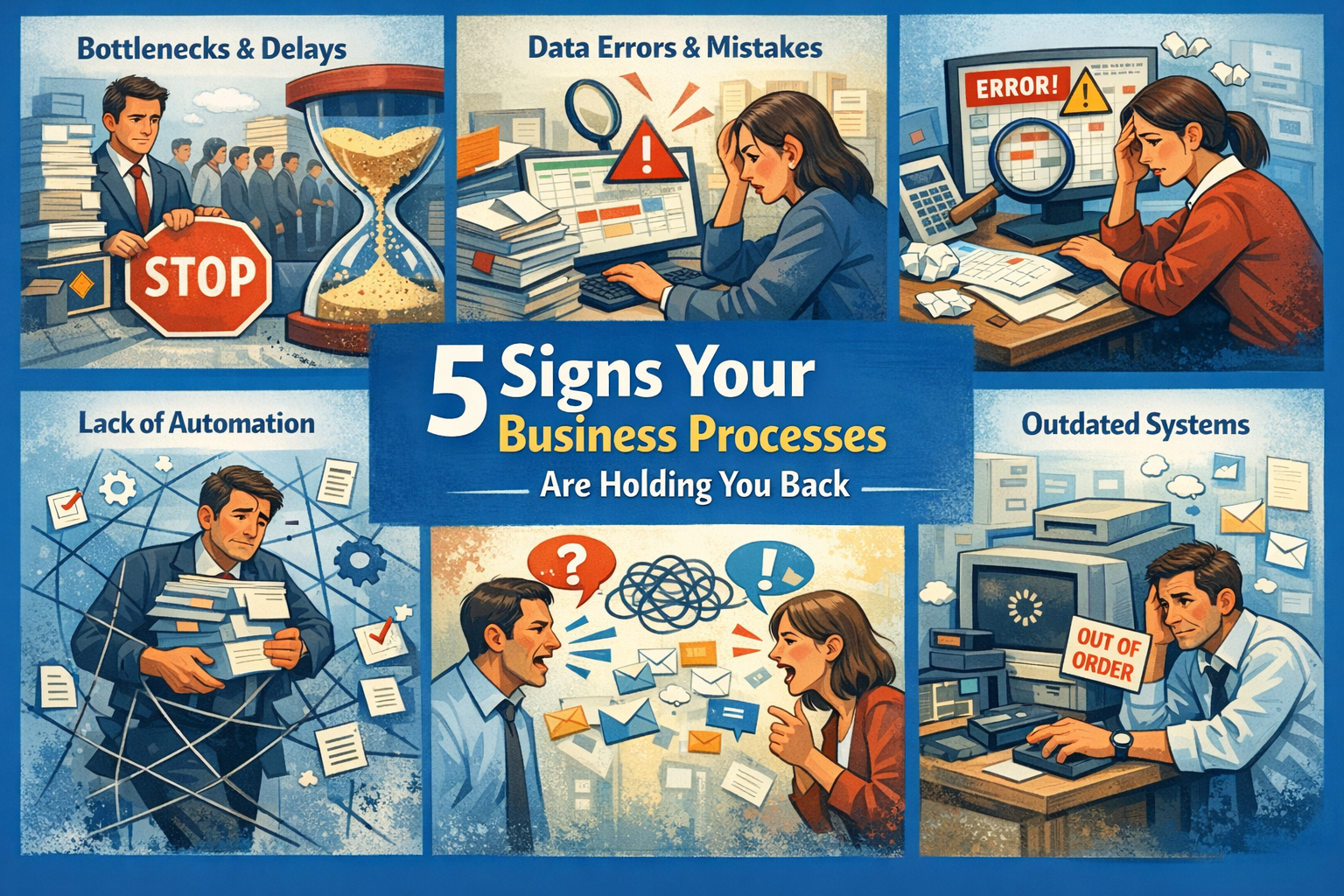
AI accelerates work, but many business processes were designed for a slower environment. They rely on manual reviews, spreadsheet handoffs, status meetings, email approvals, and informal knowledge held by a few experienced employees.
When AI enters that environment, the bottleneck simply moves. The system may generate insights faster, but decisions still wait for the same approval chain. Reports may be produced faster, but teams still debate which data source is correct. Customer requests may be categorized faster, but resolution still depends on unclear ownership.
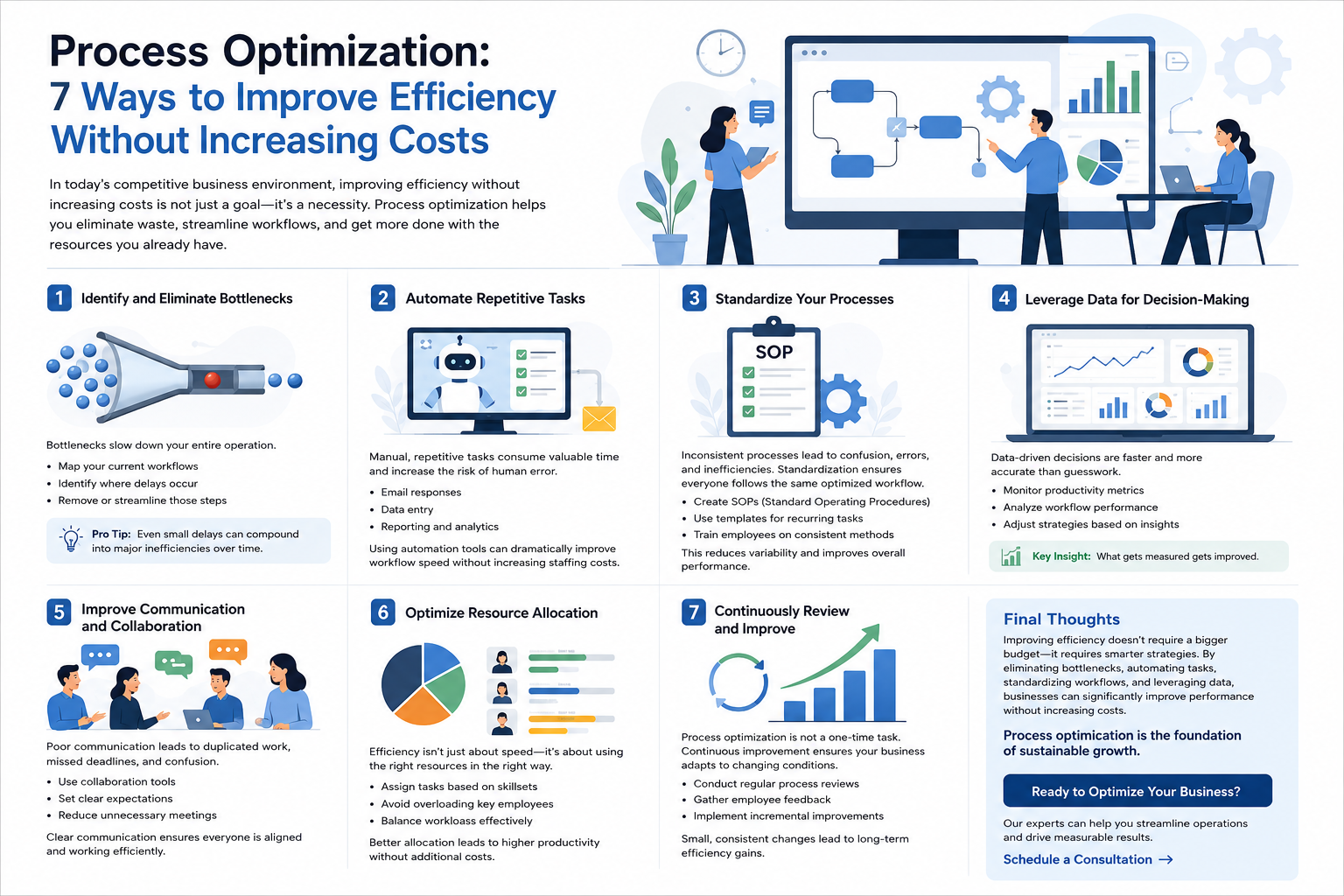
What to do: Map your highest-value workflows from start to finish. Look for delays, rework, manual handoffs, unclear ownership, and repeated decisions. Then redesign the process around speed, accountability, and measurable outcomes before automating it.
3. Decision Rights Are Unclear
AI can support faster decisions, but only if your organization knows who has the authority to act. If every decision escalates to leadership, AI will not create agility. It will create more information for leaders to review.
As AI becomes part of forecasting, customer segmentation, hiring support, pricing analysis, risk detection, and operational planning, companies need clear decision rights. Leaders must define which decisions can be automated, which require human review, and which require executive approval.
What to do: Create a decision-rights framework. Define who is responsible, who is accountable, who must be consulted, and who simply needs to be informed. This is especially important for AI-supported decisions that affect customers, employees, compliance, or financial outcomes.
4. Your KPIs Measure Activity Instead of Impact
One of the biggest mistakes companies make with AI is measuring usage instead of value. The number of AI tools deployed, prompts submitted, or documents generated does not prove business impact.
The better question is whether AI is improving the outcomes that matter: cycle time, cost-to-serve, revenue growth, conversion rates, customer satisfaction, employee productivity, forecast accuracy, quality, risk reduction, or margin improvement.
What to do: Connect every AI initiative to a business metric. If the use case cannot be tied to performance, customer value, risk reduction, or operational efficiency, it may not be ready for investment.
5. Employees Do Not Know How Their Roles Will Change
AI transformation can create anxiety when employees believe the strategy is only about cutting labor. But the most effective transformations usually focus on redesigning roles so people spend less time on repetitive work and more time on judgment, creativity, customer relationships, problem-solving, and improvement.
Deloitte research has emphasized that organizations achieve stronger results when they redesign human and AI interaction instead of simply layering AI onto existing work. This is where change management becomes essential.
What to do: Communicate early and clearly. Show employees how workflows will change, which tasks may be automated, which responsibilities will become more important, and what training will be provided. AI adoption succeeds faster when people understand the role they play in the new operating model.
6. Risk Management Has Not Caught Up
AI creates new opportunities, but it also introduces new risks. These may include data privacy concerns, inaccurate outputs, biased recommendations, vendor dependency, unclear accountability, compliance exposure, and overreliance on automation.
Risk mitigation should not happen after AI is already embedded across the business. It should be designed into the operating model from the beginning.
What to do: Establish AI governance early. Define acceptable use, review requirements, data boundaries, escalation paths, vendor oversight, and audit procedures. The goal is not to slow innovation. The goal is to make innovation scalable and trustworthy.
How to Prepare Your Business for AI Work Redesign
AI readiness does not require every system to be perfect before you begin. But it does require a structured approach. Companies that want measurable results should focus on five practical steps.
Step 1: Start With Business Outcomes
Do not begin with the tool. Begin with the objective. Are you trying to reduce operating costs, improve customer response times, increase sales conversion, speed up reporting, reduce compliance risk, or improve resource allocation? The clearer the outcome, the easier it is to identify the right AI use case.
Step 2: Assess Current Workflows
Before redesigning work, you need to understand how work actually happens. That means reviewing processes, systems, handoffs, approvals, data sources, pain points, and performance gaps. This discovery phase often reveals that the biggest barriers to AI success are not technical. They are operational.
Step 3: Redesign Before You Automate
Automation should not preserve broken processes. If a workflow is too complex, inconsistent, or approval-heavy, AI may only make the confusion move faster. Simplify the process first. Remove unnecessary steps. Clarify ownership. Standardize inputs and outputs. Then apply AI where it can improve speed, quality, or decision-making.
Step 4: Build Governance Into the Workflow

AI governance should be practical, not theoretical. It should define how teams use AI in real business situations. Who reviews AI-generated outputs? What data can be used? Which decisions require human approval? How are errors reported? How is performance tracked? These questions should be answered before scaling AI across departments.
Step 5: Train People for the New Way of Working
AI transformation requires new habits. Employees may need training in prompt quality, data interpretation, process ownership, exception handling, AI review, and change adoption. Managers may need new tools for measuring performance and guiding teams through redesigned workflows.
What AI-Ready Companies Do Differently
AI-ready companies do not treat AI as a side project. They treat it as part of business transformation. They connect AI strategy to operating model design, performance management, change management, risk mitigation, and strategic planning.
They also avoid the trap of isolated pilots. Instead of launching disconnected experiments, they build a roadmap that prioritizes high-value use cases, prepares teams for adoption, and measures impact against real business goals.
The organizations that win with AI will be the ones that can answer these questions clearly:
- Which workflows create the most value for our customers and business?
- Where are delays, rework, and manual effort limiting performance?
- Which decisions should AI support, and which should remain human-led?
- How will roles, responsibilities, and skills need to change?
- What governance is needed to manage risk and accountability?
- Which KPIs will prove whether AI is creating measurable value?
Is Your Business Ready?
If your organization is exploring AI, the most important move is not buying another tool. It is building the operating foundation that allows AI to deliver value. That means redesigning processes, clarifying decision rights, preparing employees, strengthening governance, and aligning AI initiatives with measurable business outcomes.
AI is forcing companies to redesign how work gets done. The opportunity is significant, but so is the risk of falling behind. Businesses that act now can build faster, smarter, and more resilient operating models. Businesses that wait may find themselves with modern tools attached to outdated ways of working.
Ready to Redesign How Your Business Works?
At Solution Based Consulting, we help organizations turn complex business challenges into practical, measurable transformation plans. From business transformation and process optimization to change management, risk mitigation, and strategic planning, our team helps you assess where you are today and build a roadmap for where your business needs to go next.
If your company is ready to explore AI-driven work redesign, schedule a consultation with Solution Based Consulting today.